A global food-tech innovator developing AI models for automated pizza preparation and quality control needed fine-grained image segmentation to train their systems. Learn how Nurion Lab delivered pixel-perfect annotations that enabled ingredient recognition, consistency, and efficiency in automated kitchens.
Overview
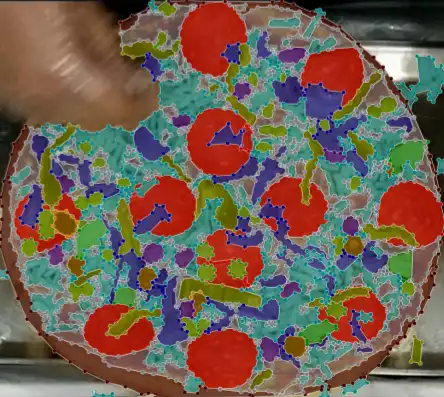
The client is a leading food-tech company focused on advancing automation in kitchen operations. Their AI system was designed to identify, segment, and analyze pizza ingredients in real time, ensuring consistent preparation quality across automated kitchens. To achieve this, the client required large-scale, pixel-level annotations of pizza images, with each ingredient segmented individually from sauce and cheese to multiple toppings and crusts. Precision was critical, as even small annotation errors could compromise AI model training.
Challenge
The project posed several significant challenges:
- Pixel-Level Accuracy: Every ingredient, including overlapping toppings, required fine-grained segmentation.
- Large Dataset: Over 100,000 high-resolution images needed to be processed for AI model training.
- Time-Intensive Work: Each frame required 2–3 hours of precise manual labeling, demanding scalable operations.
- High Precision Requirement: Even minor annotation errors could significantly affect AI recognition and performance.
Our Solution
Nurion Lab designed a tailored annotation workflow to meet the client’s high standards:
- Specialized Training: Annotators received domain-specific training to accurately identify and segment pizza ingredients.
- Advanced Segmentation Tools: Utilized polygonal and pixel-level segmentation techniques to handle complex overlapping elements.
- Scalable Workforce: Deployed a dedicated team of skilled annotators supported by multi-tiered QA processes.
- Iterative Feedback Loop: Maintained continuous collaboration with the client to refine guidelines and maximize annotation accuracy.
Outcomes
Through Nurion Lab’s patient records digitization solution, the client achieved:
- •Pixel-Perfect Accuracy: High-quality annotations across 100k images, enabling precise ingredient recognition.
- •Enhanced AI Performance: Improved model accuracy for automated preparation and quality control.
- •Efficient Scaling: Balanced the time-intensive annotation process with a streamlined workflow for faster delivery.
- •Operational Impact: Supported the client's mission to standardize food preparation in automated kitchens.